


Batch Refunds
Overview
The Batch Refunds module provides comprehensive bulk refund processing capabilities for processing multiple refunds simultaneously through CSV file uploads. It offers real-time progress tracking, status monitoring, and detailed reporting for all refund operations processed through the Juspay payment platform.
This module is designed for a wide range of users, including:
Operations Teams: For processing large volumes of refunds efficiently and monitoring refund processing performance across different payment methods and gateways.
Finance Teams: For bulk refund processing, financial reconciliation, and tracking refund amounts across multiple transactions with detailed audit trails.
Customer Support: To process customer refund requests in bulk, track refund status, and provide accurate updates to customers on refund processing.
Accessing the Module
Log in to the Juspay dashboard.
From the main navigation menu on the left, click on Payments.
Select Bulk Operations from the Payments submenu.
Click on the Refunds tab from the bulk operations navigation.
The navigation URL for this module is https://portal.juspay.in/batch/batch-refunds
 .
.
Step-by-Step Usage Instructions
Creating Batch Refunds
Step 1: Access the Batch Refunds Interface
Navigate to the Batch Refunds module using the steps above.
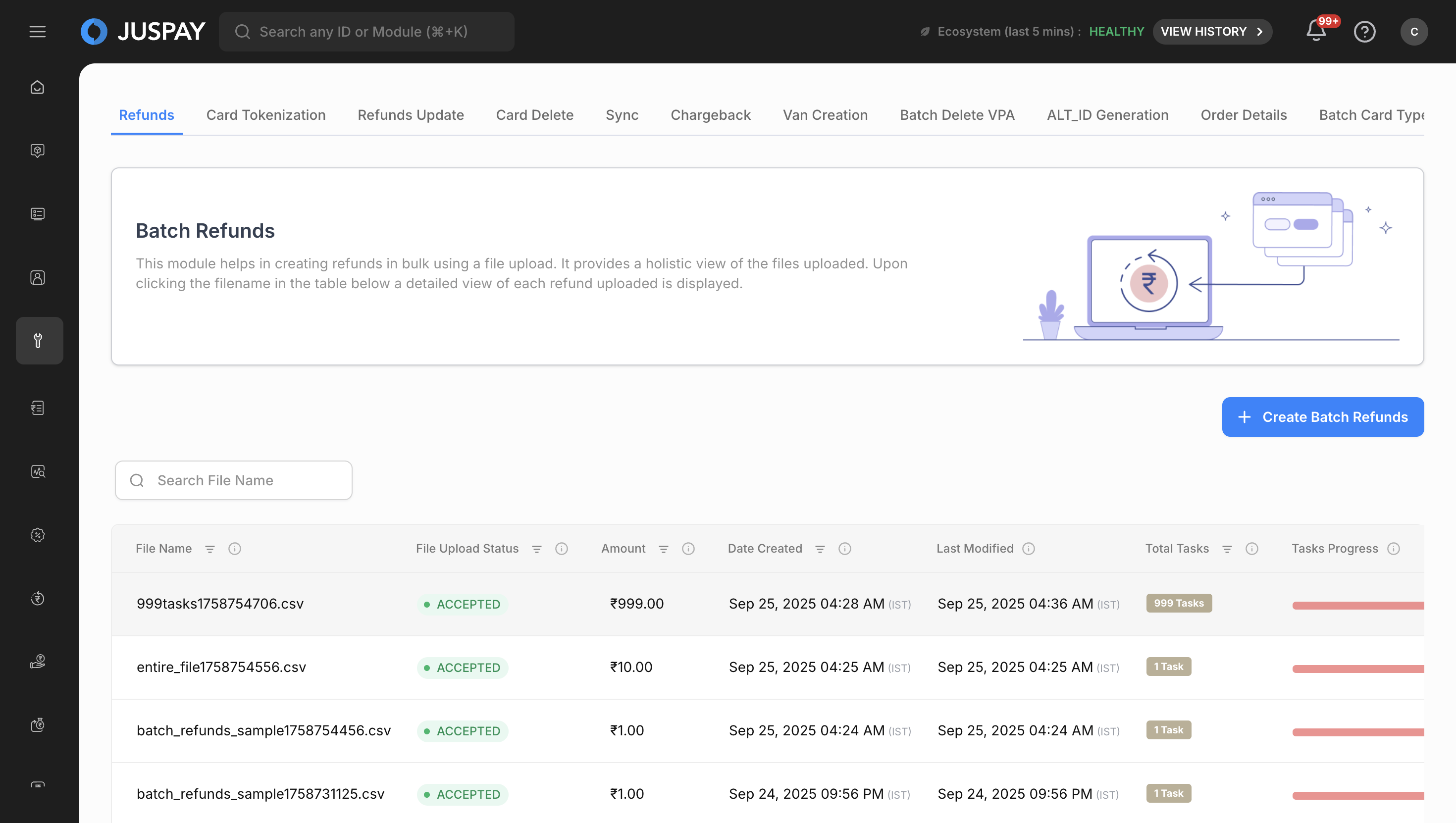
You will see the main dashboard with a description: "This module helps in creating refunds in bulk using a file upload. It provides a holistic view of the files uploaded. Upon clicking the filename in the table below a detailed view of each refund uploaded is displayed."
The interface displays any previously uploaded batch refund files in a table format.
Step 2: Initiate New Batch Refund Upload
Click the "Create Batch Refunds" button (visible only to users with appropriate permissions).
If maker-checker workflow is enabled for your account, you will first see a description modal:
Enter a description for the batch refund request in the text field.
Click "Submit" to proceed to the file upload interface.
If maker-checker is not enabled, you will directly access the file upload interface.
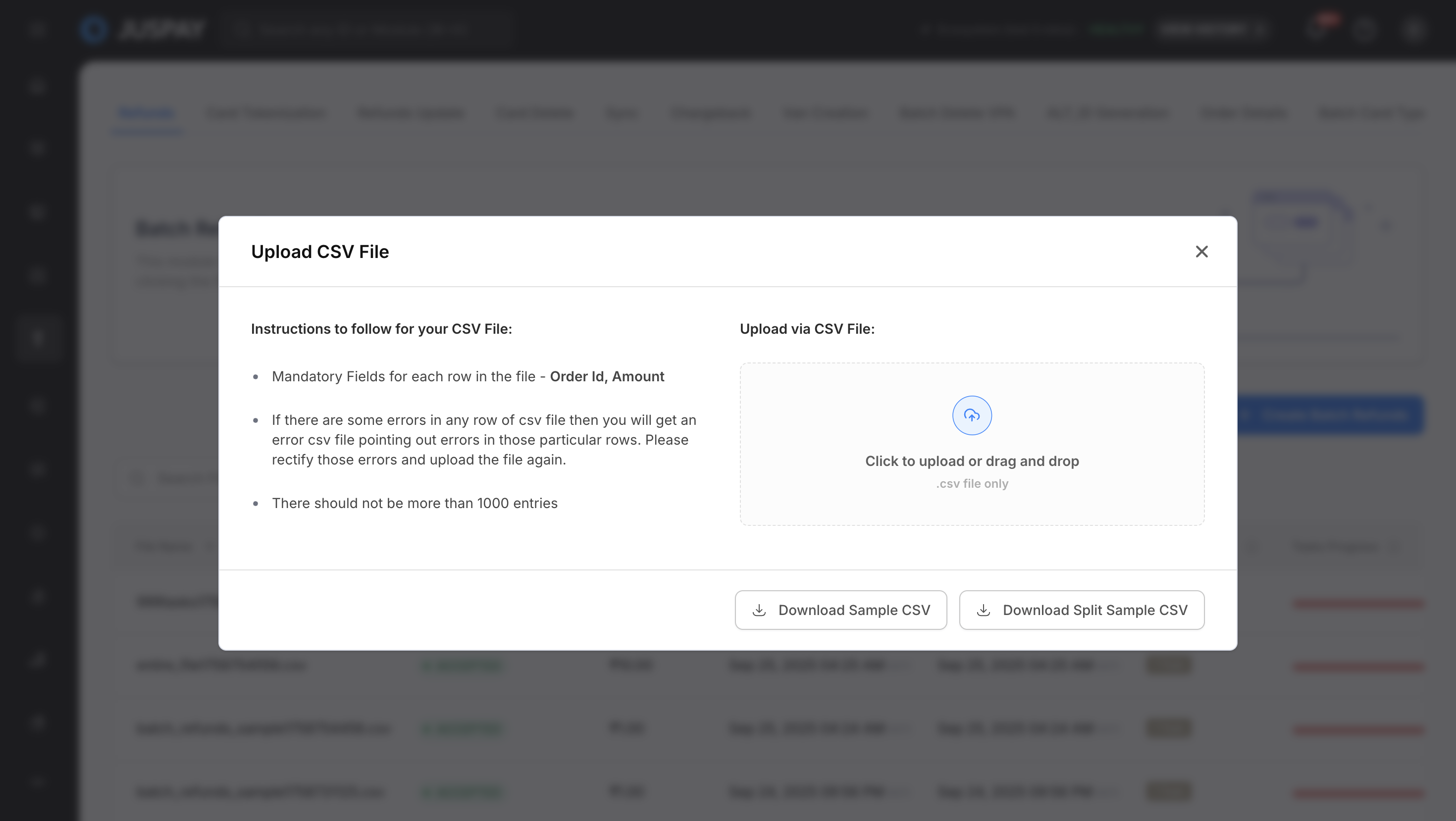
Step 3: Prepare and Upload CSV File
Download Sample File: Click on the sample file link to download the CSV template (
batch_refunds_sample.csv).Prepare Your Data: Fill in your refund data following the CSV field specifications (see table below).
File Limitations:
Maximum 1000 rows per file
CSV format only
File size limitations apply
Upload Process:
Click "Choose File" or drag and drop your CSV file
The system validates the file format and structure
Mandatory fields are checked (Order ID and Amount)
Column types are validated (Order ID as String, Amount as Number)
Step 4: File Processing and Validation
File Validation: The system performs the following checks:
CSV format validation
Mandatory field presence (order_id, amount)
Data type validation for each column
Row count validation (maximum 1000 rows)
Error Handling: If validation fails, specific error messages are displayed:
Missing mandatory fields
Invalid data types
File format errors
Row limit exceeded
Successful Upload: Upon successful validation:
File is queued for processing
Batch ID is generated
Initial status is set to processing
Step 5: Monitor Processing Status
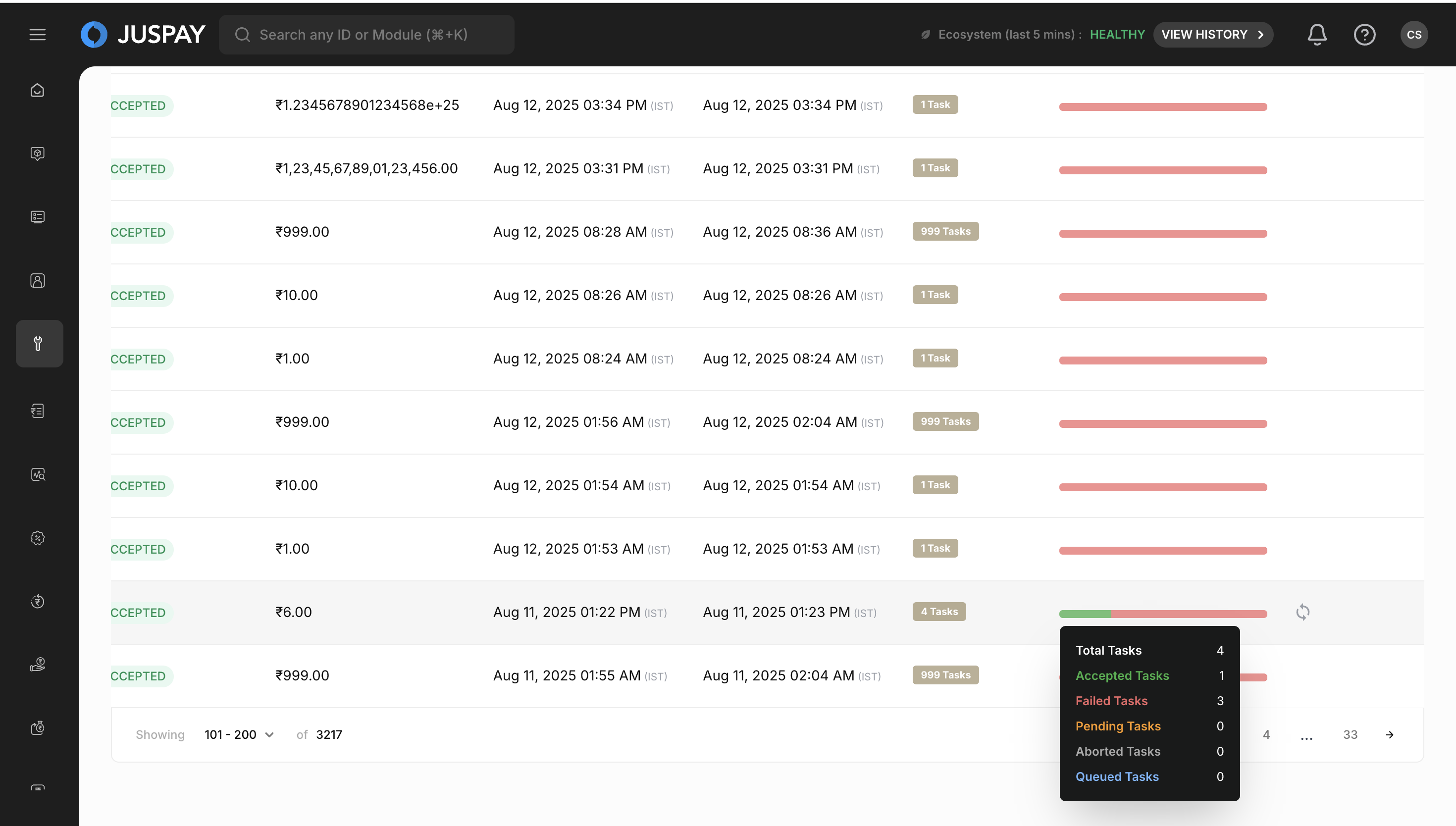
Status Indicators:
ACCEPTED: Successfully processed refunds (Green indicator)
FAILED: Failed refund attempts (Red indicator)
QUEUED: Refunds waiting in processing queue (Blue indicator)
Monitoring and Managing Batch Refunds
Viewing Batch Refund Details
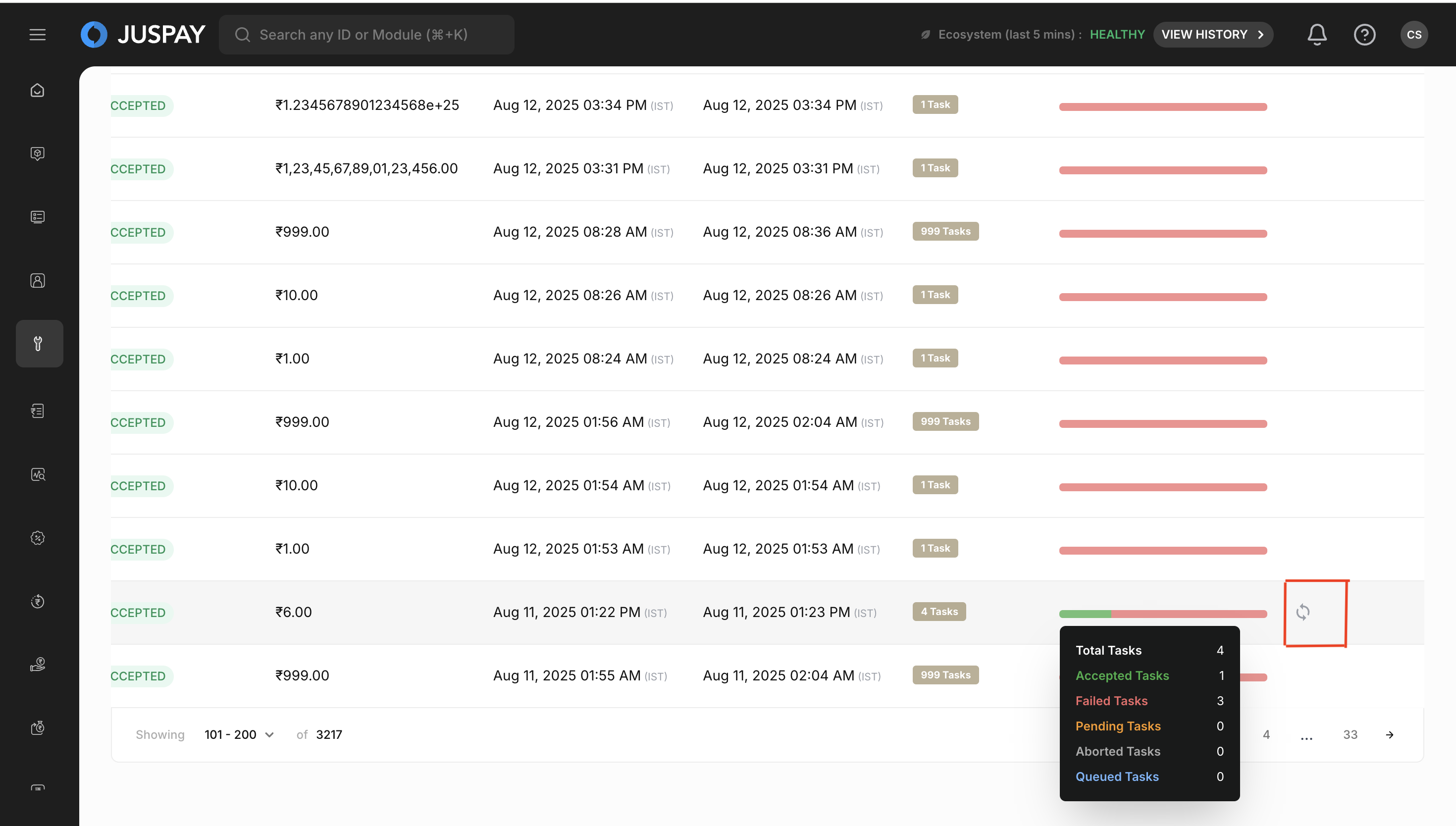
Table View: The main interface displays all uploaded batch files with:
File Name: Name of the uploaded CSV file
File Upload Status: Current processing status with color-coded labels
Amount: Sum of refund amounts in the uploaded file (displayed in INR currency)
Date Created: File upload timestamp
Last Modified: Last update timestamp
Total Tasks: Number of refund requests in the file
Tasks Progress: Visual progress bar showing completion status
Actions: Sync with Gateway button for manual synchronization
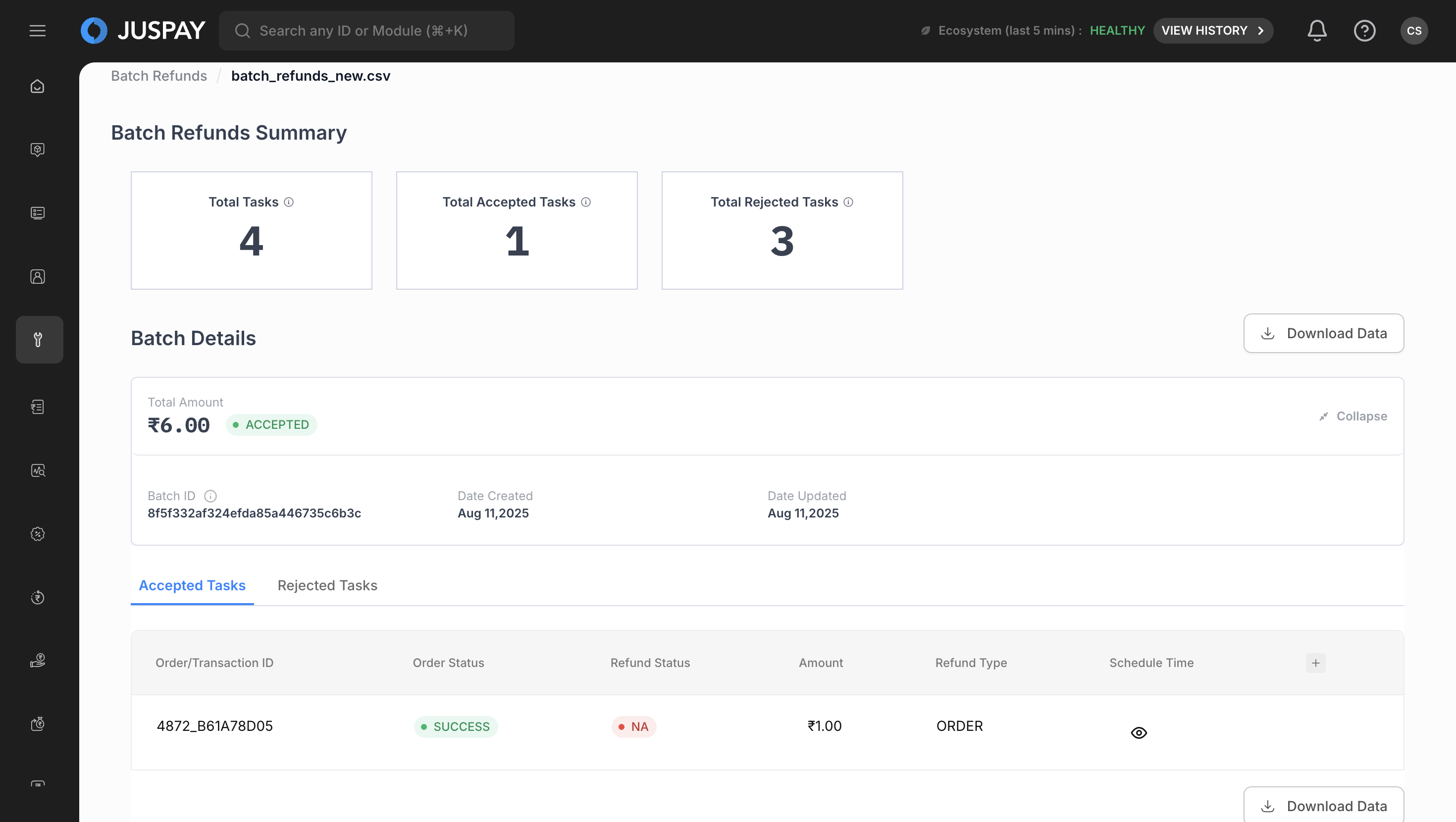
Detailed View: Click on any filename to access detailed information:
Batch Details Card: Expandable/collapsible interface showing:
Batch ID: Unique identifier for the uploaded file
Date Created and Date Updated timestamps
Total Amount with currency formatting
Current status with color-coded indicators
Progress Statistics: Individual task counts for:
Total Accepted Tasks: Successfully processed refunds
Total Rejected Tasks: Failed refund attempts
Total Queued Tasks: Refunds in processing queue
Batch Refunds - Detailed View
Search and Filter Capabilities
File Name Search:
Use the search input field with search icon
Enter filename to filter results
Search is case-sensitive and supports partial matches
Clear search using the cross icon
Table Sorting:
Click column headers to sort data
Available sorting for: File Name, Status, Amount, Date Created, Total Tasks
Toggle between ascending and descending order
Data Export and Download
Downloading Processed Data
Access Download: Click the "Download Data" button in the batch details view.
CSV Export: Downloads include:
Serial numbers (S.No column)
All processed refund data with the following headers:
Order/Transaction Id
Amount
Refund Status
Unique Id
GW Transaction Id
Udf1 through Udf10 (User Defined Fields)
Task Status
Refund Type
Error Message
Created At
Updated At
File Format:
CSV format with comma-separated values
Filename format:
batch_refund.csvIncludes header row with column names
Gateway Synchronization
Manual Sync: Click the "Sync with Gateway" button for individual batch files.
Purpose: Synchronizes refund status with payment gateway systems.
Real-time Updates: Status updates are reflected immediately in the interface.
CSV File Upload Specifications
CSV Field Requirements
|
Field Name
|
Mandatory/Optional
|
Data Type
|
Description
|
Sample Value
|
Validation Rules
|
|---|---|---|---|---|---|
order_id
| Mandatory
| String
| Unique order identifier for the transaction to be refunded
| "ORD_123456789"
| Must be a valid string, cannot be empty
|
amount
| Mandatory
| Number
| Refund amount to be processed
| 100.50
| Must be a valid numeric value, supports decimal places
|
txn_id
| Optional
| String
| Transaction ID for the specific transaction
| "TXN_987654321"
| String value, can be empty
|
unique_id
| Optional
| String
| Unique identifier for the refund request
| "REFUNIQUE001"
| String value, can be empty
|
marketplace_amount
| Optional
| Number
| Amount for marketplace in split settlement
| 75.25
| Numeric value for split settlement scenarios
|
vendor1_id
| Optional
| String
| First vendor ID for split settlement
| "VENDOR_001"
| String value for split settlement
|
vendor1_amount
| Optional
| Number
| Amount for first vendor in split settlement
| 15.00
| Numeric value for split settlement
|
vendor2_id
| Optional
| String
| Second vendor ID for split settlement
| "VENDOR_002"
| String value for split settlement
|
vendor2_amount
| Optional
| Number
| Amount for second vendor in split settlement
| 10.25
| Numeric value for split settlement
|
udf1
| Optional
| String
| User Defined Field 1
| "CustomValue1"
| String value, custom data field
|
udf2
| Optional
| String
| User Defined Field 2
| "CustomValue2"
| String value, custom data field
|
udf3
| Optional
| String
| User Defined Field 3
| "CustomValue3"
| String value, custom data field
|
udf4
| Optional
| String
| User Defined Field 4
| "CustomValue4"
| String value, custom data field
|
udf5
| Optional
| String
| User Defined Field 5
| "CustomValue5"
| String value, custom data field
|
udf6
| Optional
| String
| User Defined Field 6
| "CustomValue6"
| String value, custom data field
|
udf7
| Optional
| String
| User Defined Field 7
| "CustomValue7"
| String value, custom data field
|
udf8
| Optional
| String
| User Defined Field 8
| "CustomValue8"
| String value, custom data field
|
udf9
| Optional
| String
| User Defined Field 9
| "CustomValue9"
| String value, custom data field
|
udf10
| Optional
| String
| User Defined Field 10
| "CustomValue10"
| String value, custom data field
|
CSV Format Examples
Standard Format with Sample Data:
File Upload Constraints
Maximum Rows: 1000 rows per CSV file
File Format: CSV (Comma Separated Values) only
Encoding: UTF-8 encoding recommended
File Size: Standard file size limitations apply
Column Order: Must match the specified header format
Empty Values: Optional fields can be left empty but commas must be maintained
Understanding Split Settlement Refunds
Split Settlement is a payment processing feature that allows a single transaction amount to be distributed across multiple parties - typically a marketplace and one or more vendors. When refunds are processed for split settlement transactions, the refund amounts must also be distributed proportionally among the same parties.
How Split Settlement Works in Refunds
Marketplace Model: In a typical marketplace scenario:
Marketplace Amount: The portion of the refund that goes back to the marketplace (platform fee, commission, etc.)
Vendor Amounts: The portions that go back to individual vendors who provided goods or services
Key Components:
marketplace_amount: The refund amount allocated to the marketplace/platform
vendor1_id & vendor1_amount: First vendor's identifier and their refund portion
vendor2_id & vendor2_amount: Second vendor's identifier and their refund portion
When to Use Split Settlement Refunds
E-commerce Marketplaces: When customers return products sold by different vendors through a single marketplace platform.
Service Platforms: When refunding payments for services that involved multiple service providers.
Commission-based Models: When refunds need to account for platform fees, vendor payments, and other distributed amounts.
Example Scenario
Original Transaction: ₹1000
Marketplace keeps: ₹100 (platform fee)
Vendor A receives: ₹600 (product cost)
Vendor B receives: ₹300 (shipping/handling)
Refund Processing: ₹1000 refund
marketplace_amount: ₹100
vendor1id: "VENDORA", vendor1_amount: ₹600
vendor2id: "VENDORB", vendor2_amount: ₹300
The system ensures that each party receives their proportional refund amount, maintaining accurate financial records and proper settlement distribution.
Split Settlement CSV File Upload Specifications
Split Settlement refunds are designed for marketplace and multi-vendor scenarios where a single transaction amount needs to be distributed across multiple parties during the refund process. This section provides comprehensive guidance for processing split settlement refunds through CSV uploads.
Split Settlement Field Requirements
|
Field Name
|
Mandatory/Optional
|
Data Type
|
Description
|
Sample Value
|
Validation Rules
|
|---|---|---|---|---|---|
order_id
| Mandatory
| String
| Unique order identifier for the transaction to be refunded
| "ORDMARKETPLACE001"
| Must be a valid string, cannot be empty
|
amount
| Mandatory
| Number
| Total refund amount to be processed
| 1000.00
| Must be a valid numeric value, supports decimal places
|
marketplace_amount
| Optional
| Number
| Amount allocated to the marketplace/platform
| 100.00
| Numeric value, represents platform fee or commission portion
|
vendor1_id
| Optional
| String
| First vendor identifier in the split settlement
| "VENDORELECTRONICS001"
| String value, vendor identification code
|
vendor1_amount
| Optional
| Number
| Refund amount for the first vendor
| 600.00
| Numeric value, must be positive if vendor1_id is provided
|
vendor2_id
| Optional
| String
| Second vendor identifier in the split settlement
| "VENDORSHIPPING002"
| String value, vendor identification code
|
vendor2_amount
| Optional
| Number
| Refund amount for the second vendor
| 300.00
| Numeric value, must be positive if vendor2_id is provided
|
txn_id
| Optional
| String
| Transaction ID for the specific transaction
| "TXNSPLIT001"
| String value, can be empty
|
unique_id
| Optional
| String
| Unique identifier for the refund request
| "REFSPLIT001"
| String value, can be empty
|
Split Settlement Validation Rules
Amount Distribution Validation
Total Amount Consistency: The sum of
marketplace_amount + vendor1_amount + vendor2_amountshould equal the totalamountfieldPositive Values: All amount fields must contain positive numeric values when specified
Decimal Precision: Supports up to 2 decimal places for currency precision
Minimum Amount: Each split amount must be greater than 0 if the corresponding vendor ID is provided
Vendor ID Requirements
Vendor-Amount Pairing: If
vendor1_idis provided,vendor1_amountmust also be specified, and vice versaUnique Vendor IDs:
vendor1_idandvendor2_idmust be different if both are provided
Business Logic Constraints
Marketplace Scenarios: At least one of
marketplace_amount,vendor1_amount, orvendor2_amountmust be specified for split settlementSingle Vendor: Split settlement can be used even with only one vendor (marketplace + single vendor scenario)
Maximum Vendors: Current system supports up to 2 vendors plus marketplace in a single split settlement
Split Settlement CSV Format Examples
E-commerce Marketplace Scenario
Use Cases
Bulk Customer Refund Processing
Export failed transaction data from transaction reports
Prepare CSV file with order IDs and refund amounts
Upload file through Batch Refunds interface
Monitor processing status and download results
Split Settlement Refund Management
Prepare CSV with marketplace and vendor amount breakdowns
Include vendor IDs and respective refund amounts
Upload file for automated split settlement processing
Track individual vendor refund status
Monthly Refund Reconciliation
Compile monthly refund requests from customer support
Create CSV with order IDs, amounts, and reference data in UDF fields
Process bulk refunds and export results for financial reconciliation
Use downloaded data for accounting and audit purposes
Troubleshooting
File Upload Validation Errors:
"Invalid file format": Ensure file is in CSV format with proper comma separation
"Missing mandatory fields": Verify that order_id and amount columns are present and not empty
"Row limit exceeded": Reduce file size to maximum 1000 rows per upload
"Invalid data type": Check that amount field contains only numeric values
Permissions and Roles
Access to the Batch Refunds module is controlled by the following permissions:
Refunds Module Access: Required for accessing the batch refunds interface (ACL:
refunds)Refunds Write Permission: Required for creating and uploading batch refund files (ACL:
refundswith ReadWrite access)